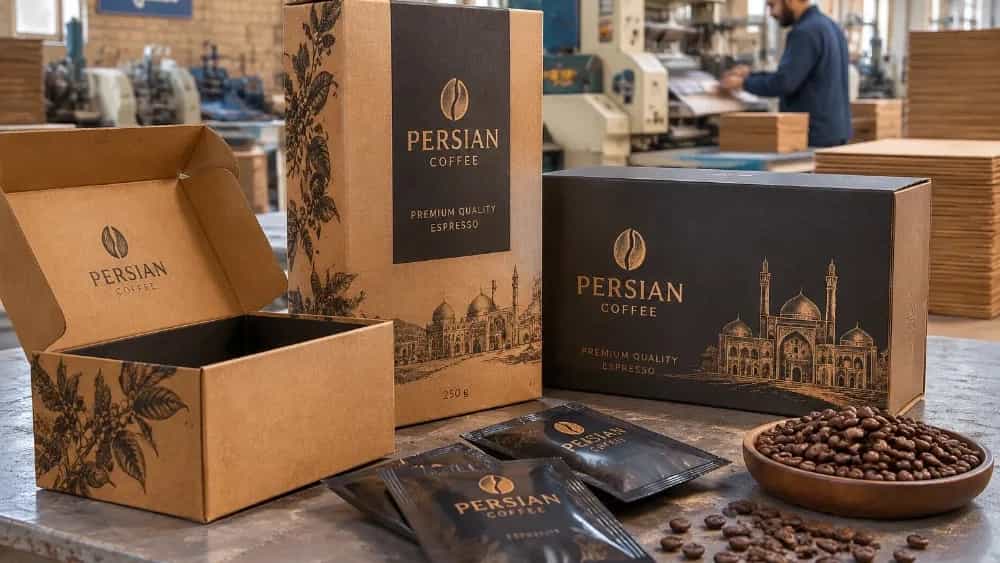
Milad Carton, as a specialized center for the production of coffee boxes in Mashhad, runs a full chain of designing, die-cutting and printing cardboard and standard hard boxes for coffee roasting. This center produces specialized packaging according to the sensitivity of coffee beans and powder to oxidation, light and regional humidity. Roastery workshops, wholesalers on Tabarsi Street and Khayyam Boulevard and retail brands in the east of the country have access to boxes that reduce the loss of coffee aroma during storage to zero through advanced cardboard and laminate lines.
Technical requirements of coffee packaging in the dry and variable climate of Mashhad
Roasting coffee beans creates a fragile and odor-absorbing structure. The extreme temperature difference between day and night in Mashhad and the foothills of Khorasan causes thermal shock to the packages and non-standard packaging draws air inside. In the production of cardboard boxes for coffee, it is not just a beautiful outer shell; Cardboard should maintain proper pressure stability in cold storage and warehouse logistics.
Selection of cardboard weight for 250 grams to one kilo packages
In industrial production lines, using cardboard below 300 grams for 250 grams packages is a common mistake; Because these boxes quickly lose their geometric form on the shelf. At Milad Karton, for packing sachets and packs weighing 250 grams to 1 kilogram, we use innerboard cardboard (FBB) with a weight of 300 to 350 grams with the orientation of longitudinal fibers so that the corners of the edges do not open under pressure.
Impact shock and wear on valve envelopes
Many brands use three-layer envelopes with valves, and the outer box is responsible for mechanical protection in long-distance transportation. Die blades must be designed so that no internal cutting edge engages the foil body or plastic valve; Otherwise, during cargo movement between Mashhad and neighboring cities, the inner envelope is perforated and the natural carbon dioxide gas of the coffee is discharged.
Anatomy of material in making hardbox, laminated and craft coffee boxes
Choosing the type of material is completely dependent on the price position of the product in the coffee market. For the use of specialty coffee lines, the manufacturing approach is different from everyday commercial coffees.
Hygienic cardboard compared to recycled kraft
For coffee packages that come in contact with steam or in the vicinity of food, Innerboard offers stunning printability due to its polished surface layer, high food hygiene and brain whiteness. On the other hand, Swedish or Russian kraft cardboard with natural earthy color conveys the sense of hand-made and eco-friendly. But in kraft cardboard, tear resistance should be tested so that it does not crack due to folding.
E-Flute carton laminate for mother and shipping cartons
5-layer and single-flute E laminated cartons are the best solutions for high-volume packaging and coffee mother cartons. Floating paper with fine congress, while absorbing road transport shocks, provides a flat surface for glossy poster laminate so that the images printed on the mother carton do not suffer from flute distortion.
Comparison of types of specialized coffee boxes
In industrial packaging lines, matching the geometric structure of the box with the manual or machine filling process is of key importance. Choosing the wrong model increases the packing time in the roastery workshop by 40%.
Coffee box model | Suggested material | Type of use / content | Impact resistance and storage | Printing system and post-printing services |
|---|---|---|---|---|
Magnetic or sliding hardbox | Grey hard cardboard + glossy or fancy coating | Specialty coffee, pack Gift, corporate gift box | Ultra high, no deformation under load | Talakub, spot UV highlight, velvet matte cellophane |
Takney box with lock (Auto-Bottom) | Underboard 300 to 350 grams | Coffee pot 250 to 500 grams, drip bag sachet | Medium to high, super fast assembly in workshop | Offset 4 to 6 colors, anti-scratch water base varnish |
E-Flute laminated carton | Single E-Flute sheet + 180g glossy poster | Mother cartons, heavy kilo packages for restaurants | Extremely high load tolerance on pallets | Laminated offset, glossy or matte protective cellophane |
Kraft box with window | Kraft 280 to 350 grams + transparent anti-vapor talc | Demi coffee, espresso capsules, store retail | medium, organic and nostalgic appearance | monochrome or two-color direct printing, window lath |
Optimizing the cost and time of producing coffee boxes for Mashhad roasted curries
Supplying cartons from the capital for coffee producers in Khorasan province always brings challenges such as high freight charges, damage to the edges of the cartons on the road, and delivery delays. Localization of orders in Mashhad's equipped factories will correct this chain.
Elimination of logistics overhead costs and real-time quality control
When the roastery workshop is located in the industrial towns of Mashhad, such as Tos, Chenaran or Kalat, the proximity to Milad Carton's die-cut and cutting lines allows for direct approval of the printed form (on the machine). The error of color deviation (Delta E), especially in the sensitive pantones of coffee brands, is detected and fixed before the entire circulation is printed.
Circulation management based on cash flow of roasting workshops
Many of the new roasters are not able to hold cash in circulations of 50,000. The flexible production approach makes it possible to make molds with lasting standards and send the order to the razor and glue line in parts corresponding to the monthly roast volume.
Custom ordering, molding and printing process in Milad Kartan
The engineering production of the coffee box begins with the calculation of the free volume of the package. A half-millimeter error in the thickness of the cardboard will cause the neck of the box to loosen or tear when closing.
Platter sampling before making the mold
Before starting the stage of laser mold and mandrel and matrix manufacturing, a raw sample of cardboard is cut with a plotter blade on the real material. The roaster tests the envelope filled with coffee inside the plastic box to fully evaluate the exact fit of the seal, the non-contact of the tab with the body, and the vertical standing of the box on the counter.
Implementation of precise gluing and anti-dust shrink wrapping
Coffee beans have a sensitive olfactory environment. In Milad Carton, odorless blue-based adhesives (Food-Safe) are used for automatic edge gluing so that the smell of chemical solvents does not penetrate the cardboard texture. In the final phase, the pallets are loaded with stretch film and standard strapping to prevent any environmental dust from entering the carton until the moment of loading in the customer's production line.